

BLOG
3-Jaw vs. 4-Jaw: The Guide to Gripping Irregular Parts
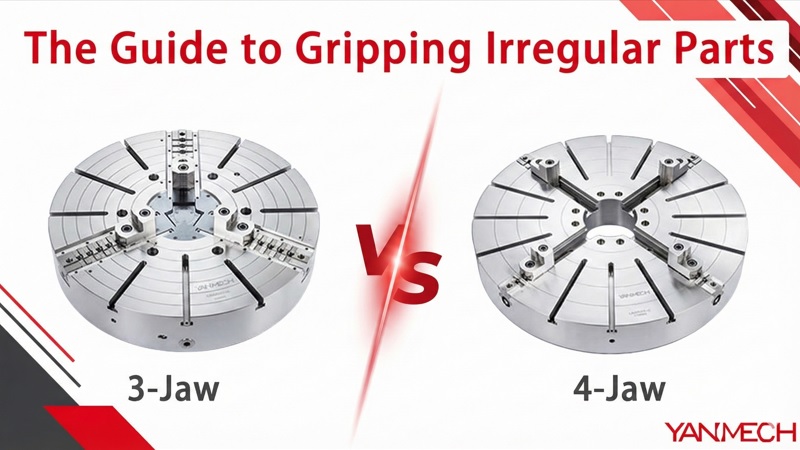
In the world of lathe machining, balancing efficiency with precision is often a tug-of-war.
For most CNC operators and purchasing managers, the 3-Jaw Scroll Chuck (Self-Centering) is the go-to standard. It's fast, convenient, and automatically centers the workpiece - an absolute lifesaver for round bars or hexagonal stock.
However, when a job order comes in featuring oddly shaped valve bodies, rough castings with uneven surfaces, or crankshafts requiring eccentric turning, the standard 3-jaw chuck often hits a wall. Attempting to use it can result in poor grip, scrapped parts, or dangerous accidents.
This is where the 4-Jaw Independent Chuck shines.
In this guide, we dive deep into the fundamental differences between these two chuck types. We will also share YANMECH INDUSTRIAL field experience in helping clients handle "impossible" irregular workpieces. We aren't just here to tell you which one to choose, but how to maximize their performance.
1. The Mechanics: Why 3-Jaw is "Fast" but 4-Jaw is "Stable"
To make the right choice, you first need to understand how they grip the workpiece differently.
The 3-Jaw Scroll Chuck: The King of Speed
The core of a 3-jaw chuck is the internal scroll plate. When you turn the pinion key, the scroll plate moves all three jaws simultaneously toward or away from the center.
-
The Pros: Extremely fast setup time and automatic self-centering. It is ideal for quick loading of round or hex materials.
-
The Cons: As the internal scroll wears down over time, the total indicated runout (T.I.R.) inevitably increases. You cannot adjust individual jaws to correct this. Furthermore, it is mechanically incapable of gripping non-symmetrical shapes.
The 4-Jaw Independent Chuck: The Guardian of Precision
In a 4-jaw independent chuck, each jaw is driven by its own independent screw. This means the operator must adjust each of the four jaws separately.
-
The Pros:
-
Maximum Gripping Force: The screw drives the jaw directly into the workpiece without the transmission loss of a scroll plate. This provides immense holding power, making it perfect for heavy-duty cutting.
-
Near-Zero Runout: Through manual calibration, you can dial the concentricity down to a near-perfect 0.005mm (or even less) - an advantage that standard scroll chucks simply cannot replace.
-
Versatility: Square blocks, rectangular parts, or irregular castings - if you can fit it in the swing, the 4-jaw can grip it.
-
2. Real-World Scenarios: When to Switch to a 4-Jaw?
Many machine shops, in an attempt to save time, try to force irregular parts into a 3-jaw chuck using shims. This is dangerous and inefficient. Here are three classic scenarios where a 4-jaw independent chuck is mandatory:
Scenario A: Square & Rectangular Parts
Not all workpieces can be pre-processed on a mill. When you need to face or bore a square block directly on a lathe, the 4-jaw is your only option. By adjusting the jaws independently, you can easily align the geometric center of a rectangular part with the spindle axis.
Scenario B: Rough Castings & Forgings
This is common in heavy industries (e.g., Oil & Gas valves, pump housings). Castings often have a rough "as-cast" surface (scale) that is uneven.
-
With a 3-Jaw: If there is a bump on one side, the other two jaws may not make full contact, leading to poor rigidity and vibration.
-
With a 4-Jaw: It adapts to the surface. You can tighten each jaw independently to match the high and low spots of the casting, ensuring every jaw has maximum contact. The grip is rock-solid, regardless of surface roughness.
Scenario C: Eccentric Turning
This is a high-level application. Suppose you are machining a crankshaft or an eccentric shaft where the feature to be machined is not on the geometric center. By intentionally loosening two opposing jaws and tightening the other two, you can "offset" the workpiece to a specific coordinate. This is a process physically impossible with a standard self-centering 3-jaw chuck.
3. Pro Tips from the Master Machinist: Dialing in a 4-Jaw
Many junior machinists fear the 4-jaw chuck for one reason: "It takes too long to center." However, with the right technique, a skilled operator can center a part in under 2 minutes.
Here is our 3-step method for rapid centering:
Step 1: The Visual Check Most 4-jaw chuck faces have concentric ring grooves. When initially clamping the part, use these rings as a visual guide to set all four jaws roughly at the same diameter. This gets you "in the ballpark" immediately.
Step 2: The Chalk Method Spin the spindle at a very low RPM. Slowly bring a piece of chalk (or the back of a tool holder) close to the workpiece surface. The chalk will mark the "High Spot" first. This tells you instantly which side is sticking out too far.
Step 3: Dialing it in (The Indicator) This is where precision happens. Place a dial indicator probe on the workpiece and rotate the spindle to find the highest reading (the high spot).
-
The Golden Rule: Identify the jaw corresponding to the high spot. Loosen the jaw opposite to the high spot slightly, then tighten the jaw on the high spot. (Think of it as pushing the high spot back toward the center).
-
Note: Always work in "opposing pairs" (e.g., adjust Jaws 1 & 3, then Jaws 2 & 4). Repeat until the needle movement is within your tolerance.
4. Advanced Strategy: The Solution for Mass Production
You might be asking: "YANMECH INDUSTRIAL, my client just ordered 10,000 irregular valve bodies. Do I really have to dial them in one by one on a 4-jaw chuck?"
Absolutely not. This is where our value as a manufacturing partner comes in.
For High-Mix, Low-Volume repair or mold work, the 4-jaw independent chuck is essential. However, for Mass Production, the solution is: A Hydraulic 3-Jaw Chuck + Custom Soft Jaws.
By installing untreated "Soft Jaws" (Raw Jaws) on a hydraulic chuck and boring them out directly on the machine to match the shape of your irregular part, we create a perfect "fixture-like" grip. This retains the "one-button clamping" efficiency of hydraulic chucks while solving the problem of gripping irregular geometries.
5. Q&A: Common Concerns from the Field
When helping international clients plan their production lines, we often hear these questions regarding chuck selection.
Q1: I see "4-Jaw Scroll Chucks" on the market. How are they different from "Independent" ones?
A: They look similar but function differently.
-
4-Jaw Scroll (Self-Centering): Works like a 3-jaw. You turn one key, and all four jaws move. It is designed only for holding square or octagonal bars quickly. It cannot correct runout and cannot grip irregular castings.
-
4-Jaw Independent: Each jaw moves separately. If you need precision calibration or need to hold odd shapes, you must choose the Independent type.
Q2: My workpiece is a thin-walled pipe. Is a 4-jaw better?
A: Not necessarily. A 3-jaw tends to deform pipes into a triangle; a 4-jaw deforms them into a square. While a 4-jaw offers slightly better pressure distribution, for extremely thin walls, we recommend Full-Grip Jaws (Pie Jaws) on a hydraulic chuck. Pie jaws wrap 360 degrees around the part, distributing pressure evenly to prevent deformation entirely.
Q3: Can I run a 4-jaw independent chuck at high speeds?
A: Proceed with caution. 4-jaw independent chucks are typically designed for heavy grip at lower speeds. This is especially true for Eccentric Turning. Since the center of gravity is intentionally offset, high RPMs can cause dangerous centrifugal vibration. Unless you are using a YANMECH model specifically balanced for specific applications, always adhere to low-RPM safety guidelines when turning eccentrically.
Conclusion: The Right Tool for the Job
When choosing a lathe chuck, there is no absolute "best," only "most suitable."
-
If you are machining standard round bars and chasing speed and automation, YANMECH INDUSTRIAL High-Speed Hydraulic Chucks are your first choice.
-
If your shop frequently handles repairs, castings, or demands extreme concentricity, a high-quality 4-Jaw Independent Chuck is the most reliable problem-solver you can own.
Struggling with a complex clamping setup? Whether you need the brute strength of a Heavy-Duty Independent Chuck or the efficiency of a custom Soft Jaw solution, YANMECH INDUSTRIAL has the engineering expertise to secure your spindle.
[Contact our technical team today] to optimize your machining precision and efficiency.