

BLOG
Hydraulic vs. Manual Lathe Chuck: Which One Should You Use?
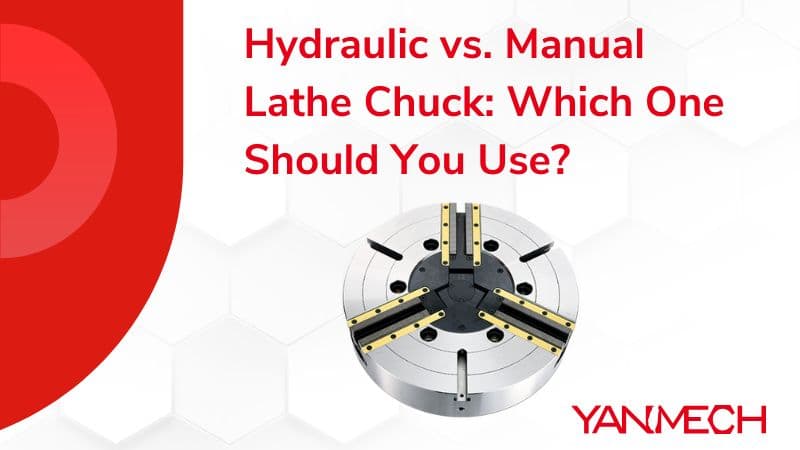
In modern metalworking, the lathe chuck is an essential component that securely holds the workpiece during rotation. Its performance directly affects machining precision, surface finish, production efficiency, and operator safety. Choosing the right chuck — manual or hydraulic — can have a major impact on overall productivity and machining quality.
Both types serve the same purpose of clamping the workpiece, but they differ significantly in operation, stability, maintenance, and application scope.
This article provides a detailed comparison of hydraulic and manual lathe chucks, combining technical insights with the manufacturing experience of YANMECH INDUSTRIAL CO., LTD., to help you make the best decision for your machining operations.
1. Manual Lathe Chuck – Principle and Features
The manual chuck is the most traditional and cost-effective clamping device. Operators use a wrench or T-handle to turn the external gears of the chuck, driving an internal scroll ring that moves the jaws in or out simultaneously to clamp or release the workpiece. Because it relies entirely on manual force, the clamping strength depends on the operator's skill and physical strength.
Advantages
(1) Simple Structure and Easy Maintenance
The manual chuck has no complex hydraulic systems or electronic controls. Regular cleaning and lubrication are usually enough to maintain stable performance.
(2) Low Initial Investment
Ideal for small workshops or training facilities, the manual chuck offers a highly economical solution for basic machining.
(3) Flexible for Small-Batch Production
When working with variable-sized or prototype parts, the manual chuck allows quick adjustments without setup complications.
(4) Suitable for Irregular or Non-Standard Workpieces
Its mechanical simplicity and flexibility make it ideal for custom or non-standard shapes that automated systems cannot easily handle.
Disadvantages
(1) Inconsistent Clamping Force
Because clamping depends on manual torque, achieving consistent pressure across parts is difficult, leading to potential runout or slippage.
(2) Lower Efficiency
Frequent manual adjustments slow down operations, making it unsuitable for high-volume production.
(3) Reduced Safety
Improper tightening may cause the workpiece to loosen or detach at high speed, posing operational hazards.
(4) Limited Automation Compatibility
Manual chucks cannot integrate with CNC control systems or provide feedback on clamping status.
2. Hydraulic Lathe Chuck – Principle and Features
The hydraulic lathe chuck operates through hydraulic pressure generated by a cylinder that transmits force to a piston mechanism. The piston then drives the jaws to clamp or release the workpiece automatically. This design ensures strong, stable, and repeatable clamping force—ideal for CNC lathes and high-volume automated production lines.
Advantages
(1) High and Consistent Clamping Force
Hydraulic control enables precise and repeatable pressure settings, ensuring uniform clamping every cycle and significantly improving machining accuracy.
(2) Excellent for High-Speed Machining
The hydraulic system minimizes vibration and eccentricity, maintaining stability even during high-RPM operations.
(3) Improved Productivity
Automatic clamping and release greatly reduce cycle times and manual intervention, optimizing mass-production workflows.
(4) Seamless Automation Integration
Hydraulic chucks can integrate with CNC controls, robotic loaders, and automatic feeders to support fully automated production.
(5) Enhanced Operational Safety
Built-in pressure holding and safety mechanisms prevent unexpected release, ensuring a secure and reliable clamping process.
Disadvantages
(1) Higher Initial and Maintenance Costs
The hydraulic system includes cylinders, valves, and piping, increasing installation and maintenance expenses.
(2) Regular Maintenance Required
Hydraulic oil quality, seal conditions, and system pressure must be monitored periodically to ensure performance stability.
(3) More Complex System Design
Hydraulic systems require careful planning for pressure routing, safety relief, and control integration during machine setup.
3. Technical Comparison
| Feature | Manual Lathe Chuck | Hydraulic Lathe Chuck |
|---|---|---|
| Operation | Tightened manually with a wrench | Automatically clamped by hydraulic cylinder |
| Clamping Stability | Variable, depends on operator | Highly stable and repeatable |
| Machining Accuracy | Moderate | High precision and concentricity |
| Workpiece Changeover | Slow, requires manual adjustment | Fast and automatic |
| Production Scale | Small batches, diverse parts | High-volume, continuous operation |
| Maintenance | Simple cleaning and lubrication | Requires hydraulic inspection and seal checks |
| Initial Cost | Low | Higher |
| Safety | Depends on operator | Reliable and safeguarded by pressure systems |
| Machine Type | Conventional or educational lathes | CNC lathes and automated lines |
4. How to Choose Between Manual and Hydraulic Chucks
Selecting the right chuck depends on your machining conditions and production goals. The following five aspects serve as a guide for making the right decision:
1. Production Volume and Frequency
- Low-volume or workshop applications → Manual Chuck
- High-volume or fully automated production → Hydraulic Chuck
2. Machining Accuracy Requirements
- Manual chucks provide decent accuracy for general work, but for parts requiring tight concentricity, rounvdness, or surface finish, hydraulic chucks deliver superior repeatability.
3. Workpiece Material and Size
- Large or hard materials demand higher clamping force, achievable only through a hydraulic system. Smaller or delicate parts, however, may benefit from the controlled touch of a manual chuck.
4. Level of Automation
- If your setup includes CNC controls, robotic loading, or automatic tool changers, hydraulic chucks are necessary for full process integration.
5. Maintenance and Overall Cost
- Manual chucks are cheaper initially but require more manual labor. In contrast, hydraulic systems cost more upfront but improve long-term efficiency, reduce rework rates, and lower per-part costs over time.
5. The Role of Hydraulic Chucks in Modern CNC Machining
As automation and smart manufacturing advance, hydraulic chucks have become standard in CNC lathes. They not only enhance precision but also ensure consistent productivity across automated production lines.
In the automotive industry, hydraulic chucks are used for crankshaft, bearing housing, and brake drum machining, maintaining stability under high-speed rotation.
In aerospace and energy applications, where titanium and nickel-based alloys are common, high clamping pressure and vibration resistance are critical—and hydraulic systems excel in these demanding environments.
Additionally, in automation-integrated systems (such as robotic loading or smart inspection lines), hydraulic chucks can be equipped with sensors and controllers for real-time pressure monitoring and remote control, advancing the move toward intelligent manufacturing.
6. The Continuing Value of Manual Chucks
Despite the dominance of hydraulic systems, manual chucks remain relevant in specific applications.
They are widely used in training facilities, mold repair, one-off parts production, and custom machining, where flexibility and low cost are priorities.
In R&D and small-scale workshops, manual chucks allow operators to make fine adjustments based on workpiece material and geometry - an ideal balance of craftsmanship and control.
In traditional manufacturing environments that emphasize tactile precision and operator experience, the manual chuck remains a trusted, irreplaceable partner.
7. YANMECH's Expertise in Chuck Manufacturing
As a professional industrial chuck manufacturer based in Taiwan, YANMECH INDUSTRIAL CO., LTD. has decades of experience in producing hydraulic chucks, manual chucks, hydraulic cylinders, and related accessories.
Our products are widely used in lathes, machining centers, and automation systems across global industries.
Our Strengths
- High-Rigidity Structural Design – Ensures stability during heavy cutting and high-speed operations.
- Precision-Ground Jaws – Maintains micron-level concentricity and minimizes machining deviation.
- Reliable Sealing and Pressure Retention Systems – Equipped with durable seals and premium hydraulic components for extended service life.
- OEM/ODM Customization – Tailored designs according to customer specifications and applications.
- Comprehensive Quality Testing – Every product undergoes dynamic balancing, concentricity checks, and life-cycle testing for consistent reliability.
At YANMECH, we combine precision engineering and manufacturing innovation to help customers worldwide achieve superior machining accuracy and productivity. Our chucks are more than tools—they are the foundation of your machining precision.
8. Conclusion: The Right Chuck Defines Your Competitiveness
In today's competitive precision manufacturing environment, choosing the right lathe chuck is not just a technical decision—it's a strategic one.
If your goal is consistent accuracy, automation, and efficiency, a hydraulic chuck is the best investment.
If you value cost control, flexibility, and craftsmanship, a manual chuck still holds great value.
No matter your production goals, YANMECH INDUSTRIAL CO., LTD. offers reliable and high-performance clamping solutions designed to elevate your machining performance and long-term competitiveness.